
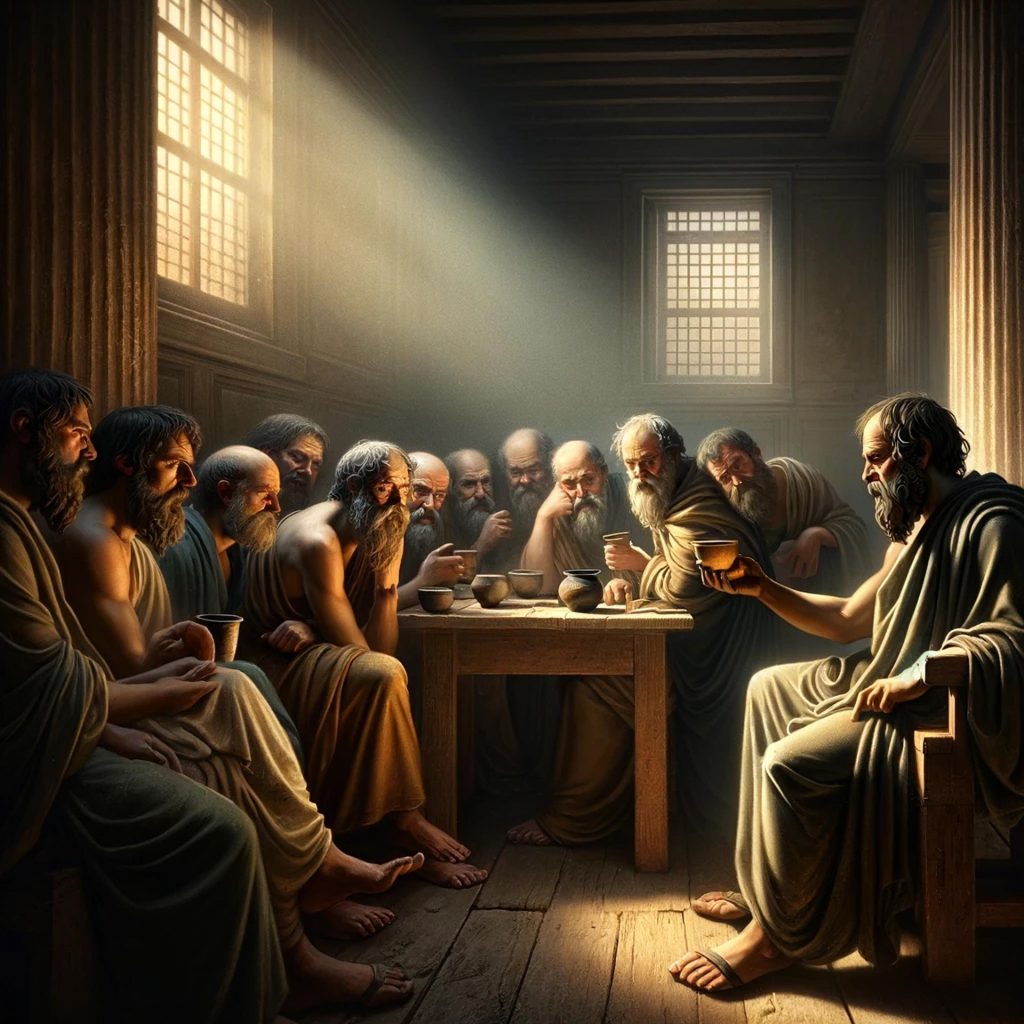
Anyone with even a little interest in philosophy has likely heard of Socrates of Athens. In this article, I will walk you through his journey and reveal the real reasons why he was arrested and sentenced to drink poison.
Most shockingly, he drank it willingly—even though he had the option to run away or agree to remain silent. Because he had developed a powerful belief about life after death, he chose death over life. I will keep this article as simple as possible to give you an idea of what his philosophy was, how he practiced it while embracing his punishment, and most importantly, the enduring message he left for us that continues to resonate centuries later.
The Curious Mind of Athens
When Socrates walked this world, Athens was rebuilding itself from the devastation of war. In the midst of this recovery, there were teachers called Sophists who taught wealthy citizens how to merely win arguments and gain power, without ever seeking the actual truth.
Born in 469 BC, Socrates developed a strong sense of curiosity during his childhood, which encouraged him to ask questions to quench his thirst for knowledge. He never wrote down any of his philosophical work, so the information the world has today comes almost entirely from his students, most notably Plato.
As he grew older, his questions became sharper. His focus was to show people that instead of fighting over the traditions of the gods, one must strive to seek the moral values that are vital to society. He was married twice; his first wife left him, and with his second wife, he had three children. Throughout his intellectual endeavors, he never maintained a consistent source of income. He was a true patriot and even fought in wars with a bravery no one could deny. But in times of peace, his mind kept driving him to guide people through reasoning.
He questioned citizens from all walks of life, aiming to remind them that civic duty and morals are far more valuable than the luxuries of life. His ideology was highly popular among the youth, a few of whom were very wealthy and influential.
Instinct vs. The Cage of the Body
Socrates presented the idea that until we are free from bodily needs, we cannot seek pure knowledge. This is why he preached that the biological body is a burden that demands too much; it gets sick, which in his opinion was a major hurdle to wisdom.
He was deeply inclined toward the purity of the soul. In his view, as long as the soul is caged in an emotionally driven body, it can never come close to true knowledge. He followed and spread this belief, keeping his own life as free from physical desires as possible, presenting himself as a true guide and seeker of knowledge.
Challenging the Wisest
His teachings grew increasingly popular because the youth, who were not aligned with old ideologies, found his arguments highly logical. Driven by these teachings, one of his friends, Chaerephon, visited the highly respected priestess, the Oracle of Delphi, and asked her: “Is anyone wiser than Socrates?”
The priestess replied: “No one is wiser than Socrates.”
When Socrates learned of this, he was shocked. In his own opinion, he knew nothing and did not consider himself wise. To himself, he was just a man in Athens who questioned people, guided them toward spirituality, and encouraged them to adopt high moral values like speaking the truth, building good character, and treating others with love and compassion.
This revelation from the Oracle prompted Socrates to try to prove her wrong. He began questioning the most influential people in society. First, he questioned the politicians, where he found that they were good speakers but actually knew nothing. Then he questioned the poets; to his extreme disappointment, he found that they could write beautiful poetry but were unable to explain its deeper meaning.
Finally, he questioned the craftsmen. Athens was famous worldwide for its craftsmanship at that time, and Socrates was hopeful they would prove the Oracle wrong. However, he was disappointed again. They possessed great skill, but they maintained an arrogant belief that they knew everything and were the wisest in all matters.
The Gadfly of Athens
While questioning the elite, Socrates sensed that he was making a lot of enemies in the highest quarters of society. Still, he was not worried and kept doing his work.
As his popularity grew, common people started to question the deceitful Sophists. These Sophists charged heavy fees to teach wealthy citizens how to enjoy worldly luxuries and win arguments just to look powerful, regardless of true knowledge. In contrast, Socrates taught on the streets free of charge, operating under the firm belief that he knew nothing.
He viewed himself as an ant biting a lazy horse, constantly nipping at it to make it move and get back on its feet, as Athenian society was heading toward a moral disaster.
This shift in society created massive discomfort for the elites. They ultimately decided to put him on trial and charged him with the following accusations:
- Corrupting the Youth: This came from the politicians as they believed that Socrates was turning the children and youth against the elites and traditions of their forefathers.
- Failing to Acknowledge the Gods of the State: This came from poets, accusing him of disrespecting the traditional Greek gods.
- Introducing New Faiths: This came from craftsmen, claiming that his ideology of the soul was superior to flesh and bones.
The Trial and Sentence
These accusations led to his arrest, and he was put on trial. Socrates defended his case brilliantly, proudly presenting his beliefs while his friend and student, Plato, watched from the huge crowd. Ultimately, the jury found him guilty, and the prosecutor demanded the death penalty.
Under Athenian law, Socrates had the right to suggest an alternative penalty, such as a fine or exile. Instead of begging for his life, he told the jury that he was already 70 years old and near the end of his life anyway. He argued that by executing him, society would be deprived of an influential philosopher, and he boldly demanded free meals for the rest of his life as a reward for his service.
He reminded them that he had never taken a dime for his teachings and had ruined his personal finances just to guide the Athenians. Therefore, he argued, he should be left alone, warning the jury that a time would come when they would carry the guilt of his death—an execution that would be remembered as one of the darkest decisions in history.
Choosing the Soul Over the Body
His arguments were in vain, and the jury voted for the death penalty. Although he had the option to beg for his life or promise to keep his mouth shut for the rest of his days, his strong belief in the afterlife convinced him that it was time for his soul to leave this world. He was certain that his soul would finally be free from his aging body and travel to a better place.
He believed that death is merely a transformation—a new beginning where an individual is held accountable for their earthly deeds. A person who committed bad deeds would face consequences, while the virtuous would be welcomed by the gods.
In Socrates’ opinion, his intentions were pure; he was ready for this transformation and eager to meet the gods to question them and seek the true knowledge that was impossible to attain while caged in a physical body.
The Refusal to Escape
The decision was finalized, and history was about to lose one of its greatest philosophers just to satisfy the egos and personal gains of a few. As per Athenian law, Socrates was sentenced to die by drinking a bowl of hemlock poison.
The night before the execution, his wealthy friend Crito made all the arrangements for an escape. However, Socrates, being a true patriot, refused the offer. He considered it a great sin to break the law, even if the law had treated him unjustly. In his view, respecting the legal framework of Athens—which had nurtured him his entire life—was far more important than his individual survival.
He believed that running away would portray him as a coward and that he wouldn’t find peace anywhere else. Crito argued that it would be deeply embarrassing for him if people thought he valued his wealth too much to save his friend.
Socrates acknowledged Crito’s love but stood firm: breaking the law would set a terrible precedent for the future, ruin society, and bring shame upon his family. He did not want them to suffer just so he could cling to a few more years of life.
Ultimately, he was happy and eager for his soul to leave this worldly circus. He looked forward to a new beginning where he could continue his quest for wisdom without physical burdens. His love for Athens made it easier for him to embark on the journey that would set him free.
Conclusion
In today’s world, the same patterns repeat. Whoever tries to raise their voice against atrocities and injustice is often silenced one way or another. We now realize that this struggle began centuries ago, where egos and self-gain are consistently prioritized over making the world a better place.
If you have read this far, I am sure you now understand Socrates’ ideology and his profound love for his country, where he placed the rule of law above his own life.
What do you think of Socrates, and which personality from history inspires you the most? Please share your thoughts in the comments below.