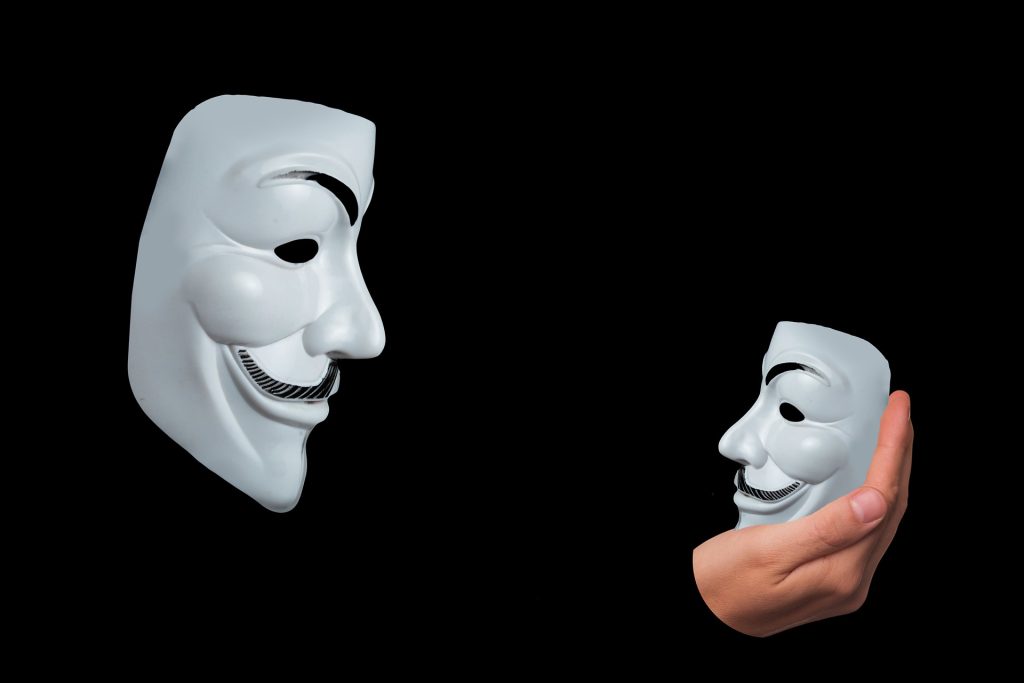

Jung’s persona theory and Socratic confrontation explain why narcissistic managers manipulate through masks — and how Stoic philosophy helps you respond.
Narcissism at Work
The Mask That Manipulates
Carl Jung called it the persona — the mask each of us wears to move through the roles life assigns: professional, parent, friend, subordinate. He didn’t think there was anything sinister about it. A persona is compromise, the price of living among other people. What interested him more was what happened when a person forgot the mask was a mask — when the performance replaced the self entirely, and the shadow underneath went unexamined for so long that any confrontation felt like an attack on existence itself.
Twenty-four centuries before Jung wrote a word, Socrates was doing something that looks, in hindsight, almost clinical. He’d stop a general in the agora and ask him to define courage, then dismantle the answer question by question until the general stood there exposed, contradicting himself in public. Athens didn’t love him for it. They executed him for it. What made men like that dangerous wasn’t cruelty — Socrates claimed he only wanted to help people examine their lives — it was that his questions didn’t attack opinions, they attacked the persona holding the opinions together.
I’ve come to think the discomfort in both cases is diagnostic, but not of everyone equally. Ordinary people, confronted with a gap between how they present and who they are, feel something like embarrassment. It passes. They adjust, sometimes even thank you for it later. Narcissists don’t do that. For a narcissist, the persona isn’t a costume over a stable self — it is the self, or the only self they can bear to inhabit, propped up entirely by whatever admiration, compliance, or fear it can extract from the room. Confront that mask and you’re not correcting a mistaken opinion. You’re threatening the only structure holding the person together. Psychoanalyst Heinz Kohut had a term for what happens next: narcissistic injury, and the rage that follows it isn’t really about you at all — it’s the sound of scaffolding shaking.
I watched this play out for two years under a regional head I’ll call the way I remember him: immaculate in meetings, generous with praise in front of senior management, endlessly quotable in town halls about “servant leadership.” Behind that, in the smaller rooms where no one senior was watching, he ran on a simple exchange. Loyalty and unpaid overreach bought access — invitations to the meetings that mattered, credit routed his way but visibility routed yours. Question a decision in front of him privately, gently, the way you’d raise a real concern with someone you respected, and something changed in his face before he even answered. Not anger exactly. A recalibration. The charm didn’t disappear so much as go cold and procedural, like a machine switching from persuasion mode to control mode.
The corporate world has a name for the strategic version of this, drawn from research by psychologist Robert Hare and industrial psychologist Paul Babiak, who studied how narcissistic and psychopathic traits actually get rewarded rather than screened out in modern management hierarchies. Charm, confidence, and a gift for appearing decisive read, to most organizations, as leadership potential. Nobody in that boardroom sees the private ledger being kept of who’s useful and who’s a threat, because the persona was built precisely to make sure they never do.
What I hadn’t expected was the second act — what happens once you stop paying the toll. I pulled back the unpaid weekends, stopped covering for his missed deadlines with senior leadership, started saying “let me think about that” instead of immediately agreeing. The change wasn’t gradual. It was fast, and it looked less like disappointment than punishment: meetings I used to be in, I was suddenly not in. A project I’d built for a year quietly reassigned “for bandwidth.” A performance review that used, almost verbatim, language he’d praised me for the year before, now reframed as a weakness. Behaviorists have a term for this pattern too, borrowed from outside psychoanalysis entirely: the extinction burst. When a reinforced behavior — in this case, my compliance — is suddenly withheld, the response isn’t calm recalibration. It’s an intensified, often punitive push to restore the old pattern, before the source either escalates further or simply moves on to someone easier to control. My manager wasn’t reacting to a business decision. He was reacting to a supply line being cut.
There’s a third piece worth naming, because it’s the one that actually gets used against you in the moment of confrontation: DARVO, a term from psychologist Jennifer Freyd’s research on how people deny wrongdoing — Deny, Attack, Reverse Victim and Offender. Raise a legitimate concern with a narcissistic manager and you rarely get a direct answer. You get the concern denied, then redirected back at you as evidence of your own attitude problem, until somehow you’re the one apologizing by the end of the conversation you started in order to hold someone else accountable.
The Stoics, oddly, had already mapped most of this territory, though they were more interested in your response than in diagnosing the other person. Epictetus told his students to think of themselves as actors handed a role in a play they didn’t write: “Remember that you are an actor in a play, the character of which is determined by the author… for this is your duty, to act well the part that is given to you; but to select the part belongs to another.” The point wasn’t resignation. It was the opposite of what the narcissist does — knowing the mask is a mask, playing the part without ever confusing it for the whole of you, so that no one else’s reaction to your performance can shake something that was never load-bearing to begin with.
Marcus Aurelius, writing to no one but himself, kept returning to a version of the same discipline: “If any man can convince me and show me that I do not think or act right, I will gladly change; for I seek the truth, by which no man was ever injured.” That’s the entire difference between the Socratic confrontation and the narcissistic injury it triggers in others, written by an emperor who had every reason in the world never to have to hear it. Truth doesn’t threaten a self that isn’t fused to its own performance.
What I’d tell anyone sitting across the table from a manager like mine is not to try to win the confrontation, because you can’t out-argue a persona defending its own survival. You also can’t fix it, because the mask isn’t yours to remove. What you can control, in the Stoic sense, is how much of your own stability you’re willing to tie to their reaction — whether their approval or displeasure gets to decide your worth for the day, or whether you can, like Epictetus’s actor, deliver your lines well and let the review of the performance belong to someone else. Document what happens, quietly and without confrontation, not as ammunition but as a way of trusting your own memory over a story someone else keeps trying to rewrite. And recognize the extinction burst for what it is — not proof you did something wrong, but proof the supply line mattered more to them than you thought. That, more than anything Socrates asked in the agora, is the question worth sitting with: not what’s wrong with the person wearing the mask, but how much of your own sense of self you’ve quietly let depend on whether they take it off.
Recognize this manager? Tell me what the mask-slip looked like for you — comments are open.