
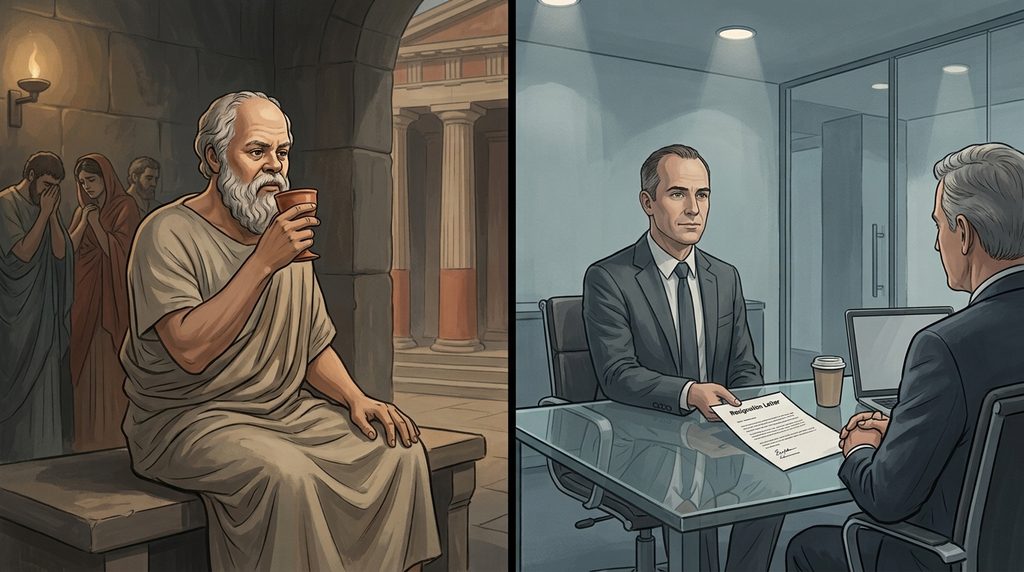
Why did Socrates drink poison rather than flee Athens? His choice mirrors what happens when employees raise hard questions at work — and choose to leave rather than stay silent.
There is a moment near the end of Plato’s Apology that I think about more than almost anything else I’ve read. Socrates has just been sentenced to death by a jury of five hundred Athenians, men he had spent his life quietly humiliating by asking them simple questions they could not answer. And instead of despairing, he turns to the jury and tells them, more or less, that they have done him no harm. Death, he says, is one of two things: either a dreamless sleep, in which case it is a relief from a life he no longer wished to keep negotiating, or a migration to another place, where he would finally get to keep company with truer, wiser people than the ones who had just condemned him. Either way, he wins. He had already refused an escape plan offered to him by his friend Crito — he could have fled Athens quietly and lived out his years elsewhere — but he chose the poison instead, because leaving would have meant betraying the very principles that got him into that courtroom in the first place.
I spent eleven years at one of the most reputable banks in the country. Eleven years is long enough to stop thinking of a place as an employer and start thinking of it as something closer to a second family, with all the loyalty and blind spots that comes with. You learn the unwritten rules of a place like that the way you learn the habits of people you live with — who to loop in before a decision goes up the chain, which battles are worth the political cost, which silences are just silence and which ones are a verdict. And somewhere in that eleventh year, I started raising concerns — not loudly, not in front of an audience, just in the ordinary way you’d expect someone who had earned a seat at the table to raise them — about decisions and policies I thought were wrong.
Nobody told me to leave. Nobody needed to. What happened instead was quieter and, in its own way, more effective: the room got smaller. Meetings I used to be in, I wasn’t. Conversations that used to happen with me happened around me. Decisions that would once have come to me for a read got made and only mentioned afterward, almost as an afterthought. None of it was dramatic enough to name in a single sentence, which is exactly what made it effective — there was no incident to point to, no email to forward to HR, just a slow change in temperature that I recognized long before I could have explained it to anyone outside the building. The message was never spoken, but it was unmistakable — my opinion was no longer something the organization wanted revisited, however respectfully I offered it. I chose to leave. And it was only much later, writing about it, that I recognized the shape of what I’d done: I had, in my own small corporate way, drunk the poison.
The comparison sounds dramatic until you actually sit with the logic Socrates used, because the logic is the part that transfers, not the theatrics. Socrates wasn’t hoping for an afterlife the way a gambler hopes for a good hand. He was making an argument for indifference to the outcome — dreamless sleep is a relief, a better world is a gain, so there is no version of this that costs him anything. That is not quite my story, and I want to be honest about where the analogy strains. When I walked out of that bank, I wasn’t indifferent to what came next. I was betting — on a new organization actually valuing the kind of scrutiny that got me sidelined in the old one. That bet carried real risk in a way Socrates’ choice, philosophically speaking, did not.
But the part of the story that does transfer cleanly is the refusal. Socrates had an exit available to him and turned it down because taking it would have meant pretending he believed something he didn’t. I had an exit available to me too — I could have stopped asking the questions, gone quiet, kept collecting a paycheck from an organization that had made its preference for silence clear. Plenty of people in that seat make exactly that choice, and I understand why: it’s the more survivable option in the short run, and eleven years of built equity is not a small thing to walk away from on principle. I didn’t walk away easily, either. But I didn’t stay silent, and eventually those two things — staying and staying silent — turned out to be the same requirement wearing different names.
Marcus Aurelius, writing a few centuries later and from a very different seat of power, keeps circling a version of the same idea in his private notebook. “Very little is needed to make a happy life,” he tells himself in Book Seven of the Meditations; “it is all within yourself, in your way of thinking.” He wrote that as the most powerful man in the Roman world, which is what makes it worth taking seriously rather than dismissing as a platitude — he had every external comfort available and still concluded that none of it was where the actual problem or its solution lived. Elsewhere he reminds himself that “everything we hear is an opinion, not a fact,” and that a man should “waste no more time arguing about what a good man should be” and simply be one. Epictetus, whom Marcus Aurelius studied closely, put the underlying mechanism even more plainly: it is not events that disturb us, but our judgments about them. I didn’t have either of them in my head in the meeting rooms where I felt the walls closing in, but I recognize the discipline they’re both describing now, in hindsight — the discipline of deciding that your own sense of what’s true is not up for renegotiation just because the room has stopped agreeing with you.
This isn’t just old philosophy dressed up for a corporate audience. Organizational researchers have spent the last three decades studying almost exactly this pattern under the name psychological safety — Amy Edmondson’s work at Harvard on why teams that punish dissent quietly lose their best people, not through firing, but through the kind of environmental pressure that makes staying feel worse than leaving. There’s a related and less comfortable body of research on what’s sometimes called organizational silence — the finding, replicated across industries, that employees frequently withhold concerns they believe management already has enough information to act on, specifically because they’ve calculated that speaking up will cost them more than it gains them. That calculation isn’t paranoia. It’s usually accurate. The mechanism researchers describe is the same one Socrates faced in that courtroom, just without the hemlock: raise the uncomfortable question, watch the room’s warmth toward you cool, and eventually decide whether the cost of staying silent is lower than the cost of staying at all.
What I’ve come to believe, though, is that the employees who choose the exit over the silence aren’t behaving irrationally, even when it looks that way from the outside. They’re making the same wager Socrates made, just with worse odds and no philosophical certainty to fall back on. There’s no guarantee the next organization will be wiser or more truthful than the one you left — Socrates got his guarantee from logic, not evidence. What you get instead is simpler and less comfortable: the knowledge that you didn’t stay somewhere by pretending to believe something you didn’t. That’s a smaller, more uncertain kind of poison than the one Socrates drank. But it’s the same choice, made by the same kind of person, for the same reason.
I’m curious whether this lands the same way for people who’ve actually lived it. If you’ve ever raised a concern at work and watched the room quietly rearrange itself around you afterward — did you stay and go silent, or did you leave? And looking back now, do you think of that choice as courage, as a bet that paid off or didn’t, or as something else entirely? I’d genuinely like to hear how it played out for you.


Pingback: Why One Toxic Employee Can Trigger a "Revenge Quitting" Wave at Work - Nauman Writes